
What Goochland Tax Records Show
Keep assessment data and payment data separate from the start. In Goochland County, the Assessor maintains public nonconfidential assessment records along with annual updates, while the Treasurer handles the bill itself, payment history, account detail, and collection. The county states no assessment ratio or last revaluation year on its pages. The exact fields on the live parcel card can vary. Trust the labels shown on the current record. When a value, exemption, or account field is unclear, ask the office directly.
| Field | What It Shows | Where |
|---|---|---|
| Assessment entry | Parcel assessment information and current assessment notice | County Assessor and Parcel Viewer |
| Tax account | Current charge, account balance, and account detail | County Treasurer |
| Payment history | Prior payments and tax history after selecting the account | Treasurer portal login or inquiry detail |
| Projected date | Penalty and interest calculation through a chosen date | Legacy Treasurer inquiry |
| Exemption or land use | Confirm any applicable treatment on the live assessment record | Ask the Assessor; exact public field was not verified |
An assessed value is a tax-administration number. It is not a market appraisal. The taxable amount may differ from the assessed figure. An exemption or land-use rule may be the reason. A sale consideration recorded in a deed, when one is stated, is simply a transaction detail. It may not match what a different property would fetch. Never work backward from a bill total. Do not use it to guess market value, a tax rate, or an exemption.
Assessor and Treasurer Have Separate Roles
The Treasurer in Goochland County collects, holds, and disburses local funds. The office states it does not set assessed values. Valuation belongs to the Assessor or Commissioner of the Revenue. The split tells you where to take a question. A parcel value that looks wrong is a matter for the Assessor. A missing payment or a due balance belongs with the Treasurer. That office can review the account history.
The Assessor's public notice confirms that nonconfidential assessments are open under Virginia law. It also cautions on one point. A zoning description on the assessment site is not an official current zoning decision. The Assessor sits at 1800 Sandy Hook Road, P.O. Box 10, phone 804-556-5853. The Treasurer is at 1800 Sandy Hook Road, Suite 210, P.O. Box 188, phone 804-556-5806. The two offices share a campus. But they keep distinct property records.
Read the Assessor's public-record page before relying on any parcel value.
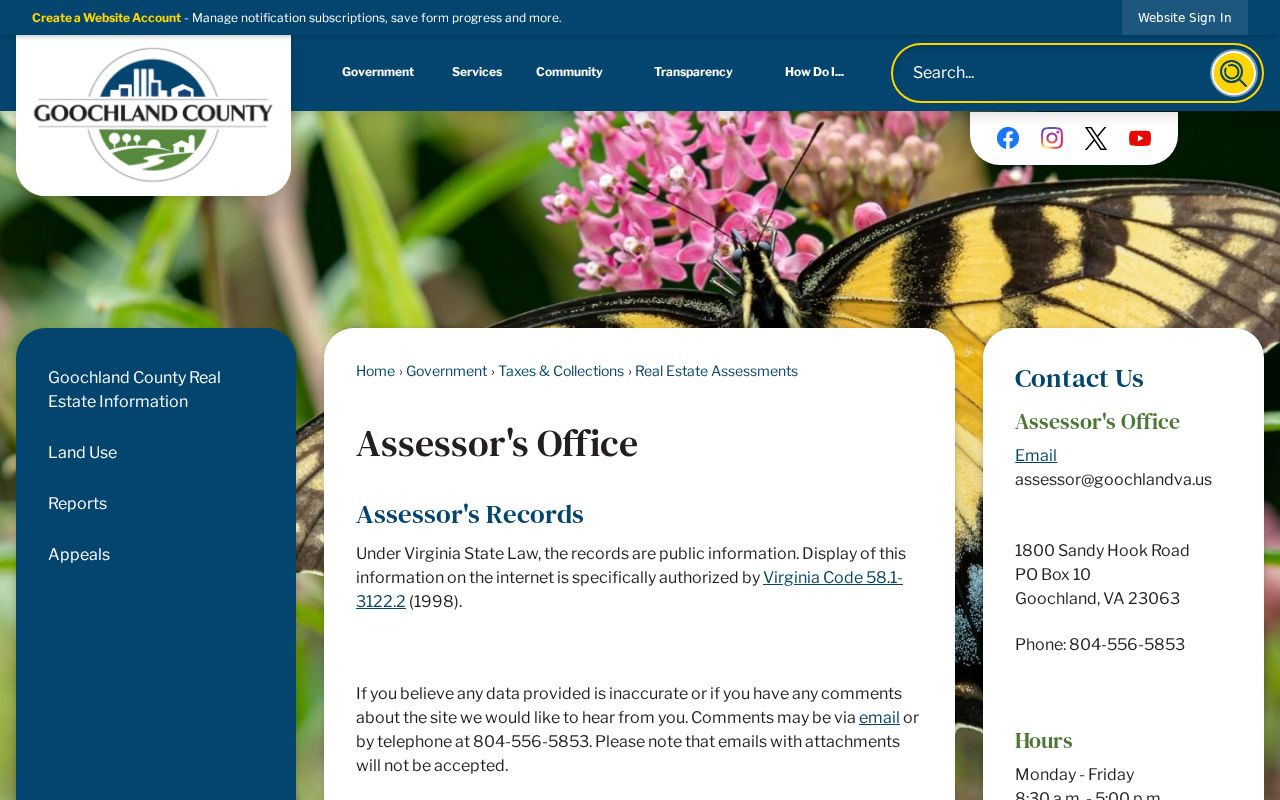
The notice identifies who maintains the value record. It also explains why a map label or zoning description should never be read as an official land-use ruling.
Goochland Assessment and Appeal Calendar
Goochland County refreshes current assessment information on the Parcel Viewer by January 15 each year. Notices go out on the business day closest to that date. An owner who wants an informal review must reach the Assessor by February 15. The county FAQ adds detail: a phone appeal must happen by 5 p.m. that day. A mailed appeal needs a postmark no later than February 15. Keep the notice, the parcel number, and any evidence supporting the correction you want.
An informal review ends with a results letter. From there, a Board of Equalization request is due within 30 days of the letter. That clock starts with the result, not with February 15. The FAQ summarizes the assessment notice and appeal dates. Read the current notice. State a clear reason, such as a factual parcel characteristic needing review. Waiting for the next bill can burn a separate appeal window that already closed.
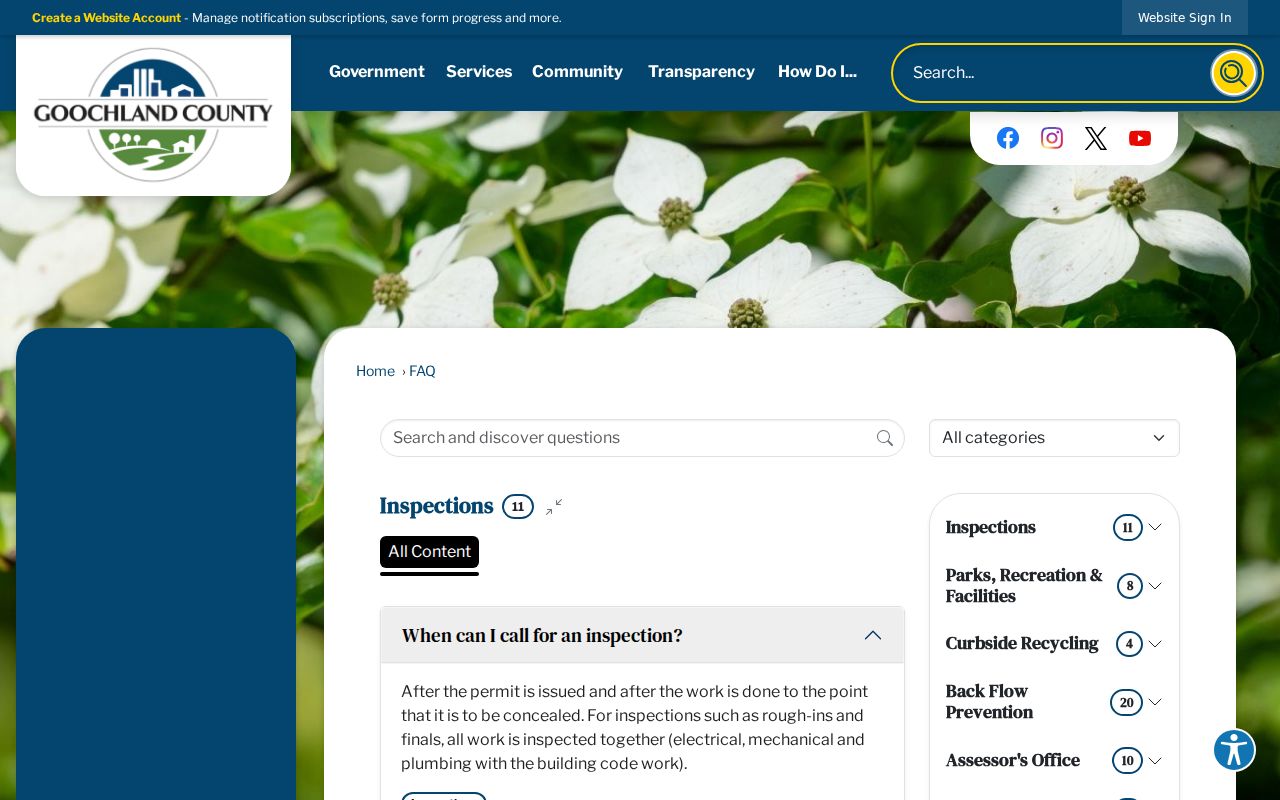
Notice timing and the Board of Equalization window are separate steps. Save the results letter, because it starts the later 30-day clock.
Finding a Goochland Tax Bill
Use the current Treasurer portal for Quick Pay and the account login. Quick Pay needs only an account number. Signing in unlocks payment history, tax history, and account actions. The older public inquiry guide also offered account number, GPIN, and street search modes. Searching by street takes extra care. Confirm the full address and parcel before opening a balance. The interface may keep shifting as Goochland County moves revenue services to Avenity.
- Open the county Treasurer portal and use Quick Pay with the account number if you only need a current payment route.
- For history or account actions, sign in and select the correct account before reviewing charges and payments.
- If using the legacy inquiry, enter the GPIN in the required spaced format or search by street, then confirm the matching parcel.
- Use a projected date only to calculate penalty and interest; it is not a receipt or proof of payment.
- Assessed value
- The value assigned for local tax administration; it is not automatically a market price.
- Tax account
- The Treasurer’s account for charges, payments, and balance associated with a parcel.
- Projected date
- A date used by the legacy inquiry to estimate penalty and interest.
- Tax lien
- A legal claim associated with unpaid tax; ask the custodian for the record and its status.
Goochland Payment Options and Portal Changes
The Treasurer takes e-check payments with no fee. Card payments carry a convenience fee. In person, Goochland County lists cash, check, money order, and card. Mail goes to P.O. Box 188, Goochland, VA 23063. A secure drop box sits on the Sandy Hook Road side of the administration building. The office answers at 804-556-5806 during weekday business hours.
On June 30, 2026, Goochland announced a change. It was implementing Avenity for Treasurer and Commissioner of Revenue services. The shift is meant to support payment processing, account management, reporting, and taxpayer self-service. A portal migration can rename menus and change sign-in behavior. So rely on the current linked county entry point, not an old screenshot, when paying. Save the confirmation afterward. If the account history does not show the payment, contact the Treasurer.
Open the Treasurer's taxpayer portal for Quick Pay and sign-in choices.
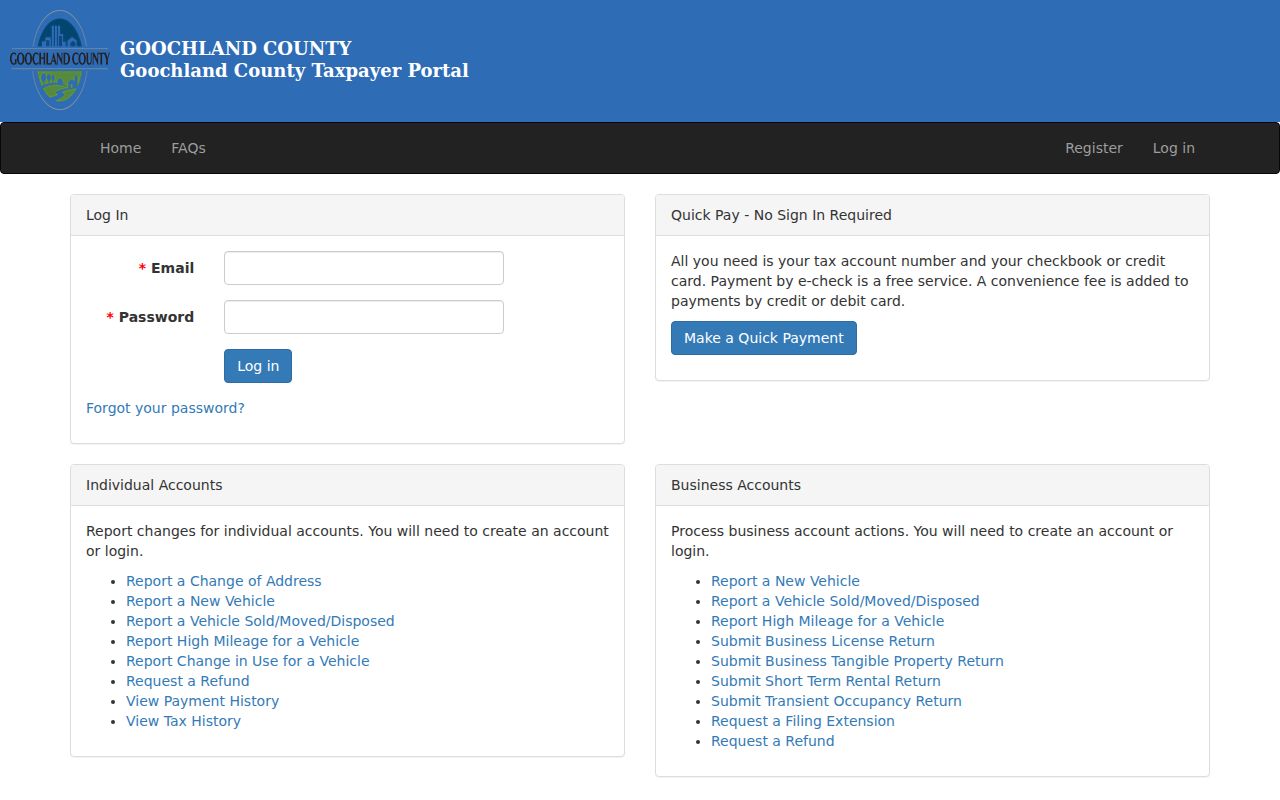
Keep the payment reference next to the account number. That pairing lets a later inquiry separate a posted payment from a projected balance.
June and December Goochland Tax Dates
Goochland real-estate taxes run on a split calendar. The two due dates are June 5 and December 5. Before paying, match the amount and account on the current bill. A past-due balance can accrue penalties and interest. The county's legacy inquiry tool will project those charges to any future date you choose. Treat the projection as an estimate. The posted payment record is what proves the county received and applied the funds.
Worried about a delinquency or a tax sale? Ask the Treasurer which notices or case records attach to the parcel. Rely on the Treasurer's current tax-sale information rather than any third-party summary. Goochland links to county tax-sale resources. But no current sale list is published here. So confirm the status directly with the office before acting on anything stale.
Goochland Property Tax Land-Book Snapshot
Goochland’s annual land books are printed as of January 1. The county FAQ says a prior owner can therefore remain on a bill after a property has sold. The name on a tax account answers who was carried into that bill’s annual roll, not necessarily who received the newest deed. Keep the bill year and the deed recording date side by side when a recent transfer is involved.
Use the Treasurer’s account inquiry to ask about charges and payment status, and use the Circuit Court Clerk’s instrument to confirm the grantee. The Treasurer collects the amount assessed but does not decide legal ownership or set the assessment. A billing mismatch should be routed to the Treasurer; a deed or vesting question belongs with the Clerk. Do not assume that the account holder’s name alone settles title.
Appealing a Goochland Assessment
Address an assessment appeal to the Assessor, not the Treasurer. Start with the current notice. Explain which parcel fact or valuation point needs review. The informal review deadline is February 15. The Assessor may issue a results letter afterward. A Board of Equalization request must follow within 30 days of that letter. Keep copies of the notice, your submission, and the response so every date stays clear.
A tax bill and an assessment are linked, but they answer different questions. The bill lists charges and payment status. The notice describes the assessed parcel and opens the appeal window. Bill errors or missing payments go to the Treasurer. A parcel characteristic, a value, or an assessment review goes to the Assessor. The public sources do not confirm exact assessment ratios, exemption field names, or a current revaluation year. Verify those details with the office before relying on them.
Appeal window. File an informal review request by February 15. After the results letter, request Board of Equalization review within 30 days; follow the current county notice for submission details.